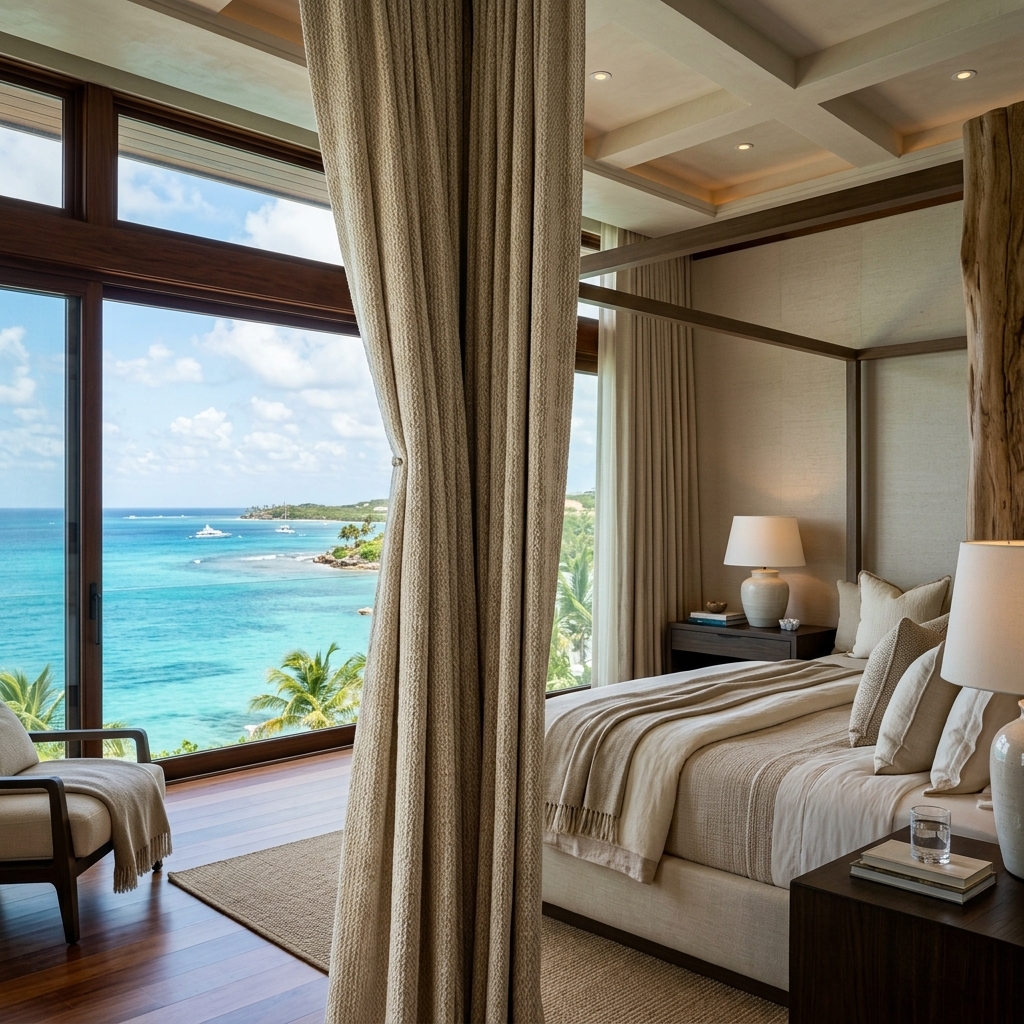
Buying blackout curtains sounds simple: pick a dark fabric, hang it, done. But in Punta Cana, where the Caribbean sun and humidity test every decision, that simplicity is a trap. Every year we meet clients who already bought their curtains and discover, weeks later, that light seeps through, heat comes in, or the fabric cannot handle the climate. The good news: almost all of these mistakes can be avoided before you spend a single peso.
At Casa Velura we manufacture and install custom blackout curtains in Punta Cana, Bavaro, Cap Cana, and La Romana, and we know the most common pitfalls well. This guide covers the frequent blackout curtain mistakes and, more importantly, how to avoid them.
Choosing the wrong fabric
The most expensive mistake is confusing "dark fabric" with "blackout". A black or charcoal fabric can let up to 30% of light through if it has no treatment. Real blackout blocks 100% of light thanks to triple-weave construction or acrylic foam backing. Before buying, ask for the technical specification or hold the fabric against a strong light source: if you see bright spots, it is not blackout.
In the Caribbean, the fabric must also withstand humidity and the salinity of the sea breeze. High-density technical polyesters are the safest choice for bedrooms in Bavaro and Cap Cana. If you want to go deeper, our guide to blackout, thermal, and acoustic curtains explains the technical differences in detail.
Getting the measurements wrong
Measuring a window seems simple, but it is where most people go wrong. The curtain width should not equal the window width: it needs at least 2 to 2.5 times that width for elegant folds, plus 15 cm beyond each side of the frame to seal out light.
Length matters too: curtains that do not reach the floor leave a strip of light and break the aesthetic. And for the large windows of La Romana villas, the exact track height can completely change the result. That is why on-site measurement is essential: every window has its own geometry.
Ignoring the track and hardware
Many clients invest in premium fabric and hang it on a standard store-bought track. Blackout is heavy: one square meter of triple weave can weigh over 500 grams. A cheap track bends, jams, and eventually damages the curtain you paid so much for.
In coastal areas like Punta Cana, salinity corrodes standard hardware within months. That is why we work with anodized aluminum tracks and marine-grade stainless steel fittings, rated for the real weight of the fabric so nothing deforms over time.
Not testing the real darkness
Blackout is sold with promises, but the real test is at your window, at the time you need darkness. A curtain can block light perfectly at the counter and fail in your east-facing bedroom, where the 6:00 a.m. sun finds every crack.
Ask for a large sample and test it hung, with daylight and with artificial light. Only then will you know if it meets your rest needs. At Casa Velura we bring samples to your space and simulate real conditions before we sew a single panel.
Forgetting side light leakage
Even with perfect fabric, light sneaks in through the sides and the top. Panels that end exactly at the window frame leave strips of light that ruin total darkness. The technical fix: install the track wider than the window and leave 15 cm of extra fabric on each side, and close the top gap with the correct track height.
This small detail is the difference between a dark bedroom and an "almost dark" one in Cap Cana villas. It is one of the adjustments our clients appreciate most after installation.
Overlooking installation
Buying the curtain is only half the job. Correct installation —track height, anchoring to concrete or coral block, reinforcements for double-height ceilings— determines whether the blackout works and lasts for years. Done wrong, it can even damage the wall.
In our experience installing across the East Zone, professional installation is the difference between a product and a solution. If you do not have your curtains yet, our guide to sheer and blackout combinations for Caribbean homes helps you plan the full system from scratch.
Planning to buy blackout curtains and do not want to get it wrong?
Request in-home consultation with samples →Conclusion: buy right the first time
Avoiding these blackout curtain mistakes in Punta Cana is not complicated: choose real blackout, measure with criteria, invest in quality tracks, test the darkness at your window, and trust installation to expert hands. Every peso well spent translates into deep, restful nights and lower electricity bills.
At Casa Velura we advise you without commitment, samples in hand and on-site measurement across the East Zone. Because a well-chosen curtain is not an expense: it is an investment in your rest.
A legacy in every line.