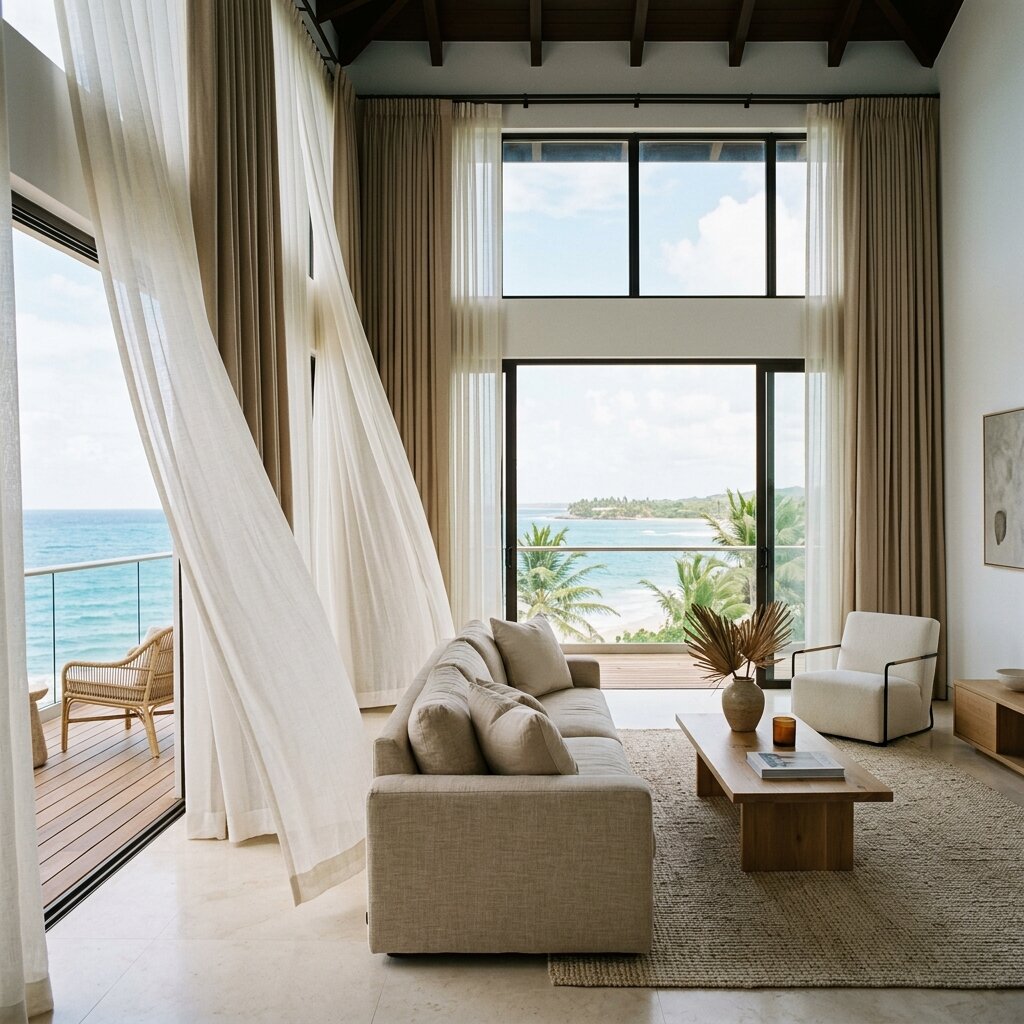
There is a phrase we hear almost daily at our Veron workshop: "I measured it myself and it did not come out right." Measuring a window seems easy, but in practice it is where 80% of custom-curtain problems are decided. A badly measured curtain cannot be fixed: it has to be remade. That is why, in this guide, we teach you how to measure your window correctly in Punta Cana, Bavaro, Cap Cana or La Romana.
At Casa Velura we manufacture and install custom curtains throughout the East Zone, and every project includes a professional on-site measurement. But we understand you may want your own measurements to quote or compare. These are the exact rules our master craftsmen use, explained step by step.
Tools you will need
Before you start, make sure you have the right tools. A 5-meter metal tape measure is essential: fabric tapes stretch and give you false readings. You will also need a pencil and paper to record each measurement separately, and a stable ladder or step stool to reach the ceiling safely.
A professional tip: always measure each dimension twice and write it down in centimeters, not inches. In the Caribbean, openings are rarely perfectly square: ceilings can be uneven and walls sloped. Measuring at three different points (left, center and right) and using the smallest reading is the standard practice in professional workshops.
Width: track and fullness
The correct width is not measured on the window itself but on where the track will go. The golden rule: the track should extend 15–20 cm beyond each side of the frame. This lets the open curtain reveal 100% of the light and makes the window appear wider. It is the same principle we use in Bavaro condos and Cap Cana penthouses.
Once you have the track width, calculate the fabric fullness: the curtain should measure between 2 and 2.5 times the width of the track. For example, a 2-meter track needs between 4 and 5 meters of fabric. Less fabric produces flat pleats; more fabric, bulky ones. This ratio applies to both wave-fold and traditional pleats.
Height: drop and distance from the floor
For the height, measure from the top of the track (or where you plan to install it) to the point where you want the curtain to end. The most common options in the East Zone are:
- Skimming the floor (1–2 cm): the modern look par excellence. The curtain almost touches the floor without dragging. This is the one we recommend most in apartments and condos.
- With a puddle (5 cm): a luxurious touch widely used in villas and hotels. The fabric pools softly on the floor and adds drama.
- Above the floor (10–15 cm): practical in high-traffic areas or with pets, but it breaks the vertical line and visually shrinks the wall.
If you mount the track 10 cm below the ceiling and the curtain reaches the floor, the effect is higher ceilings and larger spaces. It is the same optical trick we explain in our guide to curtains for small apartments.
French windows and special openings
French windows — the glass doors that open onto terraces and balconies — are stars of Punta Cana architecture. To measure them, take the full frame width, from door to door, and add 15–20 cm on each side. For the height, decide whether you want floor-length curtains or a puddle, and measure from the track to that point, without forgetting the space the handle takes up.
Measuring mistakes that ruin a curtain
After years installing curtains in the East Zone, these are the mistakes we see repeated most often:
- Measuring the window instead of the track: mistake number one. The curtain hangs from the track, not the frame, and the track is always wider.
- Forgetting the fullness: ordering exactly the track width produces a flat, pleat-less curtain that looks like a hung sheet.
- Ignoring the molding or the air conditioner: a split unit mounted above the window can block the curtain from opening.
- Assuming the ceiling is level: in Caribbean construction, a 2 cm difference between sides is common. If you measure a single point, the curtain will hang crooked.
- Rounding down: with curtains, it is always better to have a little extra fabric than too little. One centimeter less is noticeable; one more, is not.
To avoid these mistakes from the start, we recommend reading our guide to curtain trends 2026 so you can also choose the right style and color before measuring. That way you arrive at the measurement with a clear project in mind.
Not sure about your measurements?
Request a free professional measurement →When to call in the professional
There comes a point where DIY measuring stops making sense: when the project involves windows over 3 meters, double-height ceilings, motorized tracks or heavy blackout fabrics. In those cases, a measuring error does not cost meters of fabric: it costs an entire system.
At Casa Velura the technical visit is free and includes the exact measurement, an assessment of sun exposure and fabric samples so you can choose at your own pace. We work in Bavaro, Punta Cana, Cap Cana, Los Corales, Veron, La Romana and throughout the East Zone, with custom manufacturing in our workshop and professional installation. Because every window deserves to be dressed with the same attention to detail with which the rest of the home was designed.
A legacy in every line.