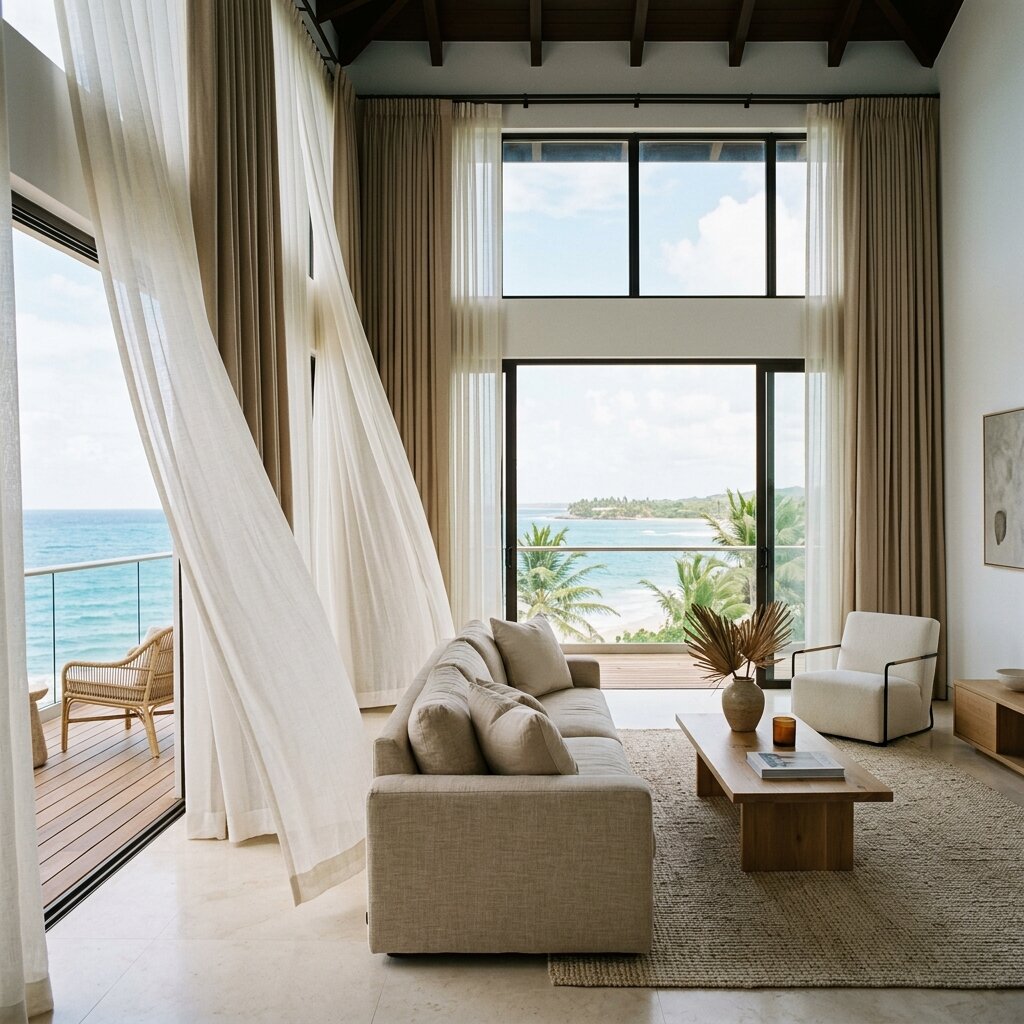
Picture this: you install beautiful curtains in your oceanfront villa in Cap Cana. Six months later, they're covered in mold spots, the fabric has warped, and the colors have faded. The culprit wasn't bad luck. It was choosing the wrong fabric for the Caribbean's most aggressive climate. The combination of 80% humidity, airborne sea salt, extreme UV radiation, and constant coastal breeze turns any textile not engineered for the tropics into an expensive lesson.
At Casa Velura, we've been dressing windows in Punta Cana, Bávaro, Cap Cana, and La Romana for years. We know exactly which fibers survive here and which ones don't. In this definitive guide, we share everything you need to know about humidity and salt-resistant fabrics so your investment lasts, not languishes.
The invisible enemy: how humidity and salt destroy your fabrics
Relative humidity in Punta Cana rarely drops below 75%. Natural fibers like cotton and linen absorb that moisture like sponges, swelling and contracting with every cycle. Over time, they lose shape, develop mold, and degrade. Salt spray — that fine layer of salt carried by the ocean breeze — accelerates corrosion of metal hardware and crystallizes inside fibers, tearing them apart from within.
A cotton curtain in a Bávaro apartment 200 meters from the sea can show visible deterioration in under a year. By contrast, the right synthetic fiber — professionally installed — holds up for five, eight, or ten seasons without losing performance or appearance. The difference lies in the fabric's chemistry.
Synthetic fibers: your allies in coastal zones
The golden rule for coastal properties in the Caribbean is simple: prioritize synthetic fibers over natural ones. Not because natural is inherently bad, but because the tropics show no mercy. Here are the three fibers we consistently recommend at Casa Velura:
- High-performance polyester: hydrophobic by nature — repels water instead of absorbing it — resistant to stretching and UV fading when solution-dyed. This is the workhorse for interior curtains in coastal areas. Versions with acrylic backing add blackout protection without sacrificing moisture resistance.
- Solution-dyed acrylic: the gold standard for exteriors and semi-open spaces. Brands like Sunbrella manufacture acrylics where pigment is integrated into the liquid fiber before spinning — not applied afterward. The result: colors that withstand years of Caribbean sun without fading, built-in water repellency, and natural mold resistance.
- Olefin (polypropylene): a lightweight fiber, extremely resistant to moisture and stains. Ideal for curtains on covered terraces, gazebos, and pool areas. Its main limitation is lower UV resistance compared to solution-dyed acrylic, so we recommend it for partially shaded spaces.
At our Verón workshop, we work with these three materials daily. The key isn't just choosing the right one but pairing it with the right hardware: marine-grade 316 stainless steel and anodized aluminum that won't rust from the saline breeze.
Do you live by the sea and your current curtains are already showing deterioration?
Request a free fabric evaluation →Natural vs. synthetic: the honest Caribbean comparison
Many clients ask us: "Why can't I use linen in my beach house if it looks so beautiful?" The answer is nuanced. Here's the real comparison:
- Cotton: natural beauty, soft touch, breathable — but — absorbs moisture, prone to mold, fades quickly in the sun. We only recommend it for bedrooms with constant air conditioning and minimal exposure to ocean breezes.
- Linen: elegant, unmatched texture, cool sensation — but — wrinkles with humidity, requires frequent maintenance, loses body in humid environments. Linen-polyester blends (70/30) offer an acceptable compromise for interior living rooms in Cap Cana.
- Technical polyester: zero moisture absorption, won't warp, color-stable, easy maintenance. Its only "downside" is lacking the organic feel of natural fibers. For clients seeking that natural look, we offer textured polyesters that mimic linen with 90% visual accuracy.
- Solution-dyed acrylic: superior UV resistance, water repellent, anti-mold, soft wool-like touch. It's the most complete material for the Caribbean. Its price is higher but its lifespan exceeds 10 years outdoors.
Anti-mold treatments: the extra layer of protection
Even high-quality synthetic fibers benefit from additional antimicrobial treatments. At Casa Velura, we apply two levels of protection:
- In-fiber treatment: antimicrobial agents integrated during the fabric manufacturing process. They don't wash out, last the curtain's entire lifespan, and actively prevent mold and bacteria formation.
- Back coating: acrylic resin layers with fungicidal additives applied to the fabric's reverse side. Recommended for bathrooms, kitchens, and any space with humidity above 85%.
For oceanfront properties in Bávaro and Punta Cana, we recommend combining both: synthetic fiber with integrated antimicrobial treatment plus back coating. It's the only configuration we've seen withstand five-plus seasons on the beachfront without issue.
Best fabrics for each room in your coastal property
Not all rooms face the same conditions. Here's our quick guide by space:
- Master bedroom (ocean-facing): technical polyester with blackout backing + anti-mold treatment. Total darkness for rest, overnight humidity resistance, and UV protection for your furniture.
- Living room with large windows: linen-polyester blend with anti-humidity treatment. Natural aesthetics with technical performance. If windows face the sea directly, opt for linen-look textured polyester.
- Covered terrace or gazebo: solution-dyed acrylic. Full UV resistance, tropical rain repellency, and anti-mold. The most durable investment for this space.
- Kitchen and bathroom: polyester with fungicidal back coating. Easy cleaning, zero moisture absorption, and splash resistance.
- Pool area: olefin or solution-dyed acrylic. Chlorine resistance, quick-drying, colors that won't degrade with constant splashing.
Maintenance: minimal but consistent
One of the major advantages of synthetic fibers is their low maintenance. Even so, in the Caribbean it's worth following three simple rules:
- Monthly vacuuming with a soft brush attachment to remove salt particles and dust before they embed.
- Cleaning with a damp cloth and neutral soap every 3-4 months. No bleach, no abrasive products. Surface mold stains are treated with white vinegar diluted to 50%.
- Hardware inspection every 6 months. On properties under 100 meters from the sea, check rails, brackets, and screws. Marine-grade stainless steel is your insurance policy.
With these care habits, a set of technical polyester or solution-dyed acrylic curtains from Casa Velura easily surpasses 8 years on the beachfront. Compare that to the year or year-and-a-half an untreated cotton curtain lasts.
Conclusion: investing in the right fabric is saving money
Choosing humidity and salt-resistant fabrics for coastal properties in Punta Cana isn't an aesthetic whim. It's a financial decision. Every dollar invested in the right synthetic fiber multiplies into years of service life, fewer replacements, protected furniture, and the peace of mind of not dealing with mold every six months.
At Casa Velura, we don't sell fabric — we design textile solutions adapted to your property's real climate. We visit your space, evaluate sea and humidity exposure, and advise you with physical samples so you make an informed decision. Because in the Caribbean, the right fabric isn't the prettiest one in the catalog: it's the one that survives your location.
A legacy in every line.