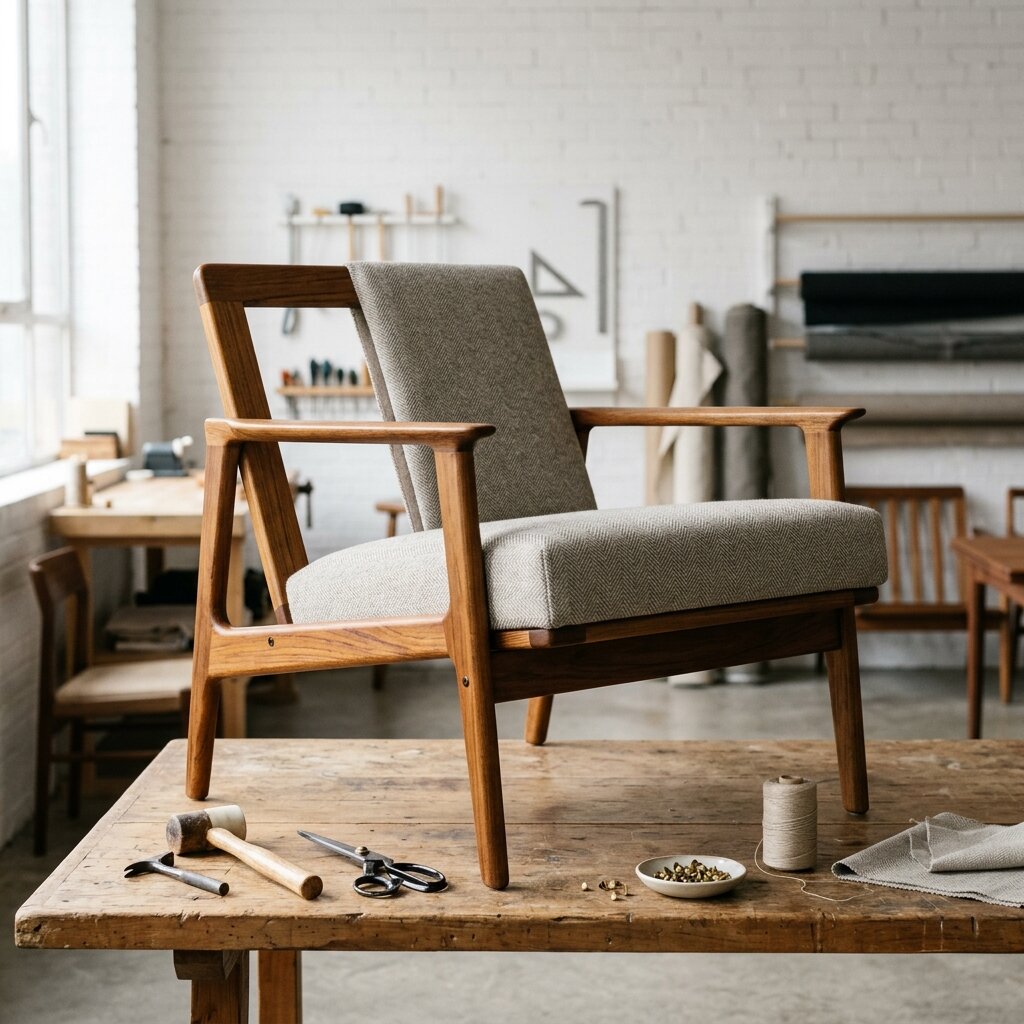
A home sofa works two hours a day. A restaurant chair works nine, and on top of that it gets dragged, knocked against the table, takes direct sun on the terrace and absorbs whatever falls off the plates. That is the real starting point of any hospitality upholstery project.
That is why furniture for a restaurant or beach club is not chosen like home furniture. It is chosen for resistance, for ease of cleaning and for availability of replacement. These are the criteria we apply at Casa Velura when we work with dining rooms, terraces and rental villas around Bavaro, Punta Cana and Cap Cana.
What really kills a dining-room chair
It is not the sitting: it is the dragging. Every time someone gets up pulling the chair, the fabric rubs against the floor and the legs are forced. In a room with 60 covers a day, that is tens of thousands of rubs a year.
The second enemy is the sun. On a west-facing terrace, fabric and foam degrade twice as fast as indoors. Without UV protection, an intense colour opens up within two seasons.
And the third is cleaning. A dining room is cleaned every day, with strong products. If the fabric is not prepared for that, every clean takes life out of it.
Contract fabrics: what we ask for in writing
Before proposing a fabric we request the data sheet and read it with the client: abrasion resistance (Martindale), colour fastness to light and rubbing, and how it behaves with the cleaning products their team uses.
On terraces and beach clubs we add moisture and mould resistance plus UV protection. In enclosed dining rooms we prioritise tight weave and stain-resistant finish.
Where the standard requires it we add a certified fire-retardant treatment. It is a common requirement in enclosed public spaces, and it is better known at the start of a project than at the end.
What you do not see: frame and foam
This is where real service life is decided. A chair lasts because its frame is reinforced at torsion points and because the foam is high density, not because the fabric is attractive.
We work with high-resilience foams and, on heavy-use pieces, new webbing and reinforced corners. Every seat recovers its shape when someone stands up instead of staying marked.
It is also what prevents the next expense: a well-padded chair can be re-upholstered twice before its frame asks to be replaced.
Re-upholster or buy new: how it is decided
The practical rule: if the frame is sound and the geometry is right, re-upholstering costs a fraction of replacing and keeps the room's style. If the structure is worn or entire pieces need replacing, we compare numbers with the client before proposing anything.
Re-upholstering has two advantages that do not show up in the price: the dining room does not change its look, and there is no import container with an uncertain date to wait for.
On a set of chairs, replacement also happens in batches with the same fabric and the same dye lot. Buying new usually brings a slightly different tone that shows as soon as it is mixed with what you already had.
Finishing before season without closing the room
The classic mistake is starting the project one month before high season. Correct planning happens three months ahead: everything is measured, the fabric is approved and the work is scheduled in phases.
We work in batches and by zone: terrace first, then the main dining room, then the bar area. Each block leaves and returns within a few days, and the room keeps operating with the rest.
When needed, we re-upholster on site for anchored or oversized pieces that cannot be moved without dismantling the space.
Maintenance: what adds two years of life
Rotating chairs from high-traffic zones to low-traffic ones every so often. It is free and it spreads the wear.
Cleaning at the moment, not at closing time: a wine spill treated in the first minutes leaves no mark.
Avoiding bleach-based products on coloured fabrics and never leaving outdoor pieces uncovered through the rainy season.
And one workshop recommendation: keep a square metre of fabric from the same dye lot. Two years later, that reserve is the difference between repairing one piece and rebuilding a block.
Why the local workshop matters on the coast
Because replacement exists. Eighteen months later, finding the same fabric and the same tone from a local supplier is possible; from an overseas purchase, almost never.
Because repair is fast. A seam that opens in peak season is resolved in days, not weeks.
And because we know the area: we know how a fabric behaves on a Bavaro terrace with salt air, and what to change depending on sun orientation. That is not in the manufacturer's catalogue.
If you also run the visibility and lead generation side of your business with the Brauny Veloz team, the same principle applies: simple, measurable decisions with people who know the area.
Frequently asked questions
Do you re-upholster at the venue itself?
Yes. For pieces that cannot be moved or are anchored to the space, we work on site with the dining room in operation. For the rest, we collect and return in batches, usually within a few days per block.
How long does it take to re-upholster 40 chairs?
It depends on the condition of the frame and padding, but a full set of 40 chairs is typically planned in phases over two to four weeks, without taking the dining room out of service at any point.
Do you work with fire-retardant fabrics?
Yes, and where the space requires it we use certified treatment. We define it at the start of the project together with the fabric data sheet, because it affects selection and lead time.
How is this different from upholstering home furniture?
In the requirements. In hospitality, fabric, foam and frame are chosen for abrasion, sun and daily cleaning resistance, not for aesthetic preference. It is the same craft with contract-grade criteria.
Do you have a dining room to get ready before season?