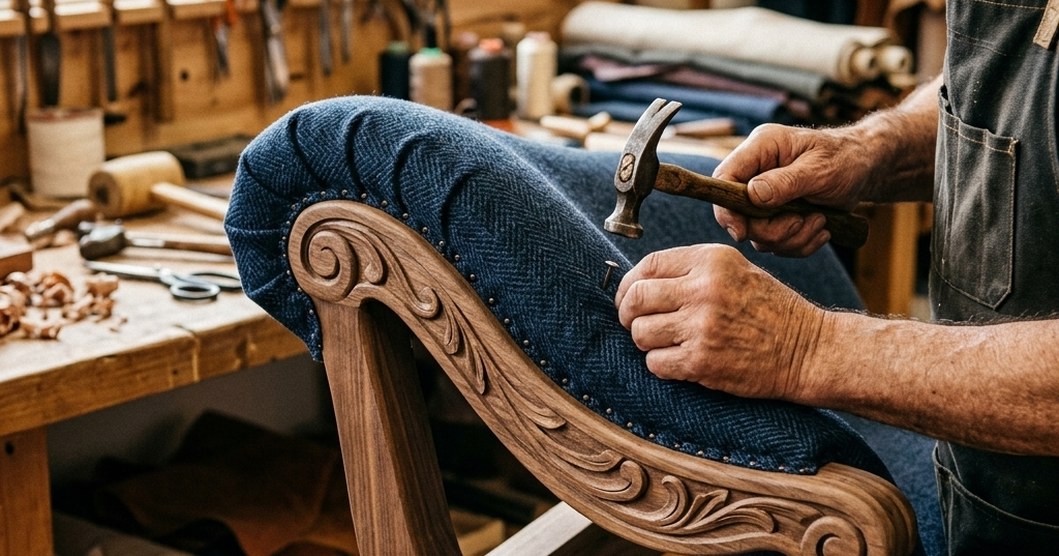
At the Casa Velura workshop in Veron, we get many visits with the same question: “which wood should I choose for my furniture?”. And the right answer does not start with price or looks, but with climate. In Punta Cana, Bavaro, Cap Cana and the whole East Zone, humidity, sea breeze and sun make wood warp, split or grow fungus if it is not chosen and treated well. In this guide we walk you, step by step, through how to choose the wood to create custom furniture from scratch.
Solid wood vs. panels: why it matters
The first decision is structural. Solid wood and panels (MDF, particleboard, plywood) are not the same. Panels are made from particles or sheets glued with resins and, although cheaper and more uniform, they absorb Caribbean humidity: they swell, delaminate, or lose screws over time. Solid wood, on the other hand, is a single natural block that —properly dried and treated— stands up to weight, heavy use and the tropical climate. For furniture meant to be passed down, solid wood is the only serious choice.
The ideal woods for the Caribbean (mahogany, cedar, oak, teak)
In the Dominican Republic we have noble woods with a fine cabinetmaking tradition. Mahogany (swietenia mahagoni) is the queen: dense, stable, elegant grain and a beauty that improves with age. Cedar is aromatic, easy to work with and very resistant to fungus and insects — ideal for headboards, wardrobes and paneling. Oak adds hardness and a striking grain, perfect for tables and structures that take knocks. And teak, though more expensive, is the marine wood par excellence: its natural oil protects it from humidity and salt air, which is why it is widely used on terraces and pieces exposed to the elements in beachfront villas in Bavaro and Cap Cana.
Drying and curing: the step almost everyone ignores
This is where a professional piece stands apart from a mediocre one. Freshly cut wood contains 40 to 60% water. If it is worked without drying, as it loses moisture it contracts, twists and cracks. That is why at Casa Velura we insist on kiln-dried wood down to a 10-12% moisture content. Natural air-drying is slow and, in our climate, never reaches that equilibrium. Curing is also a resting process: the wood must stabilize and “get used” to the local climate before it becomes furniture. Asking your carpenter about the moisture percentage and the drying process is the best way to avoid your piece warping within a year.
Tropical treatment: humidity, salt air and fungus
Choosing the right wood is only half the job. The other half is protecting it. In the tropics, the 75-90% humidity and the salty coastal air are silent enemies. In the workshop we apply marine-grade finishes: high-performance polyurethane varnishes or penetrating oils with anti-UV and water-repellent additives. Hardware matters too: we use 304 or 316 stainless steel and anodized aluminum, because commercial iron rusts in the salt air. We also keep wood off direct contact with the ground in damp areas and seal the joints so water cannot get in. Without this treatment, even the best wood ends up aging poorly.
Want a wooden piece that lasts decades in the Caribbean?
Book your consultation with Casa Velura →How to choose the wood for your custom project
When we take on a piece in Bavaro, Cap Cana or Veron, we follow a simple process. First we assess where the piece will live: direct sun or sea breeze exposure? Indoor or outdoor use? Then we choose the wood according to function: mahogany for hero pieces, cedar for casegoods and wardrobes, teak for outdoor, and oak for surfaces that take knocks. We adapt the design to the grain and natural color, avoiding dyes that hide the figure. Finally, we apply the right marine finish and record the moisture content of every batch. The result is a piece that looks as beautiful ten years on as it did on day one.
This protocol applies whether it is a one-of-a-kind dining table or the complete furnishing of a villa in Cap Cana or a boutique hotel in Bavaro. The scale changes; the discipline with the wood does not.