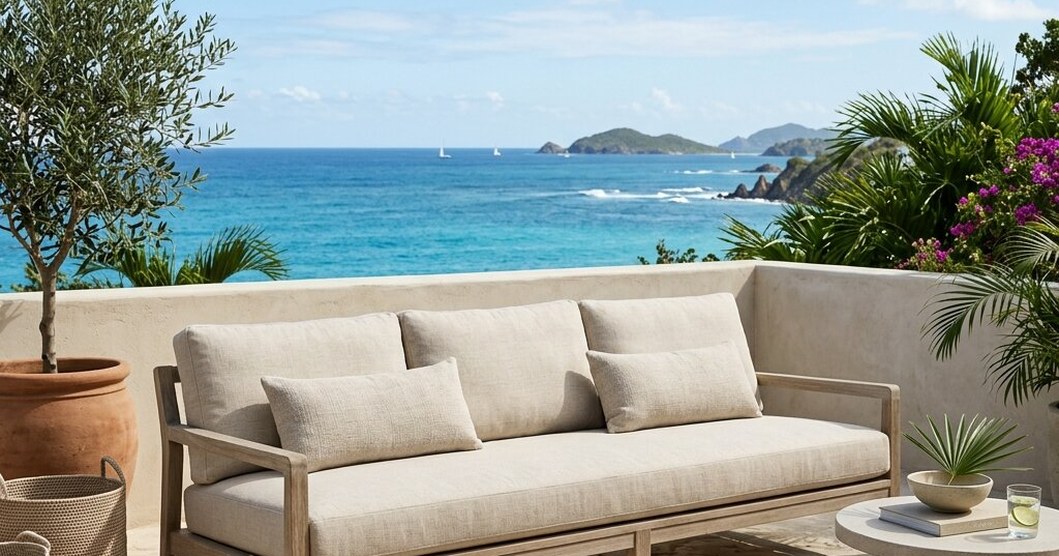
There is a subtle but enormous difference between a sofa that simply looks good and one that feels good for years. The first is achieved in a showroom; the second, in a workshop like Casa Velura, where every piece is thought through, measured, and built by hand, without shortcuts that compromise the result. Artisanal upholstery is not a fad: it is a way of understanding furniture as an extension of the body and of the space.
In this guide we walk you through the artisanal process of making a custom sofa from scratch. It is the same journey our clients follow in Punta Cana, Bavaro, Cap Cana, and Veron: from a sketch to that first afternoon when you sit down and everything, simply, fits. We want you to understand each stage so that, when you sit down, you appreciate the hours of work behind every cushion.
What is a custom sofa and why make it from scratch?
A custom sofa is not a sofa that is "bigger or smaller." It is a piece conceived for the exact proportions of your living room, the orientation of the light, the traffic in your home, and the way your family sits. When you buy a catalog piece, you silently accept its dimensions, its firmness, and its fabric. When you make it from scratch, those decisions are yours: the seat depth, the backrest height, the angle of the arms, and even the exact size of every cushion.
Moreover, building from scratch lets us use materials that last: solid woods, high-density foams, and fabrics that do not fade under the Caribbean sun. It is the difference between replacing a sofa every three years and inheriting one that stays firm. And in a region where good taste and quality are part of everyday life, a custom piece becomes the heart of the living room.
From the very first meeting, our team listens to how you live in your home: whether there are children jumping on the cushions, whether pets climb onto the seats, whether the living room is the gathering point on Punta Cana afternoons. That conversation shapes the design long before a single plank of wood is touched.
From design to frame: the wood that holds everything together
It all begins on paper and, today as well, on screen. We take measurements of the space, study the traffic flow, and define a design that balances aesthetics and function. Only then does it move to the workshop, where the master carpenter cuts the frame pieces using solid woods such as oak, walnut, or cedar, kiln-dried to 12% moisture, forming a skeleton in which every rail serves a load-bearing purpose.
That drying matters enormously in a climate like Punta Cana's: poorly cured wood swells, cracks, and loosens its joints in tropical humidity, and within months the sofa starts to creak. That is why our joints are glued and screwed, never stapled or held with pressed cardboard. The frame is the skeleton that supports every cushion, and it is what determines whether the sofa creaks or gives way over the years. It is, literally, the invisible that holds up all that is visible.
Along the way we also reinforce the points of greatest tension, such as the corners and the joint with the arms, using wood blocks and metal braces. This obsession with detail is what allows a Casa Velura sofa to withstand the daily use of a family or the constant flow of a hotel lobby in the East Zone.
Foam and padding: the soul of comfort
With the frame ready, it is time to give it a soul. This is where a sofa feels different to the touch. We use high-density polyurethane foam (32–35 kg/m³), which stays firm year after year instead of sagging within months. Then each seat and backrest receives layers of padding that distribute pressure and give that supportive feeling that hugs without sinking.
This stage is also what defines the real comfort of your living room in Bavaro or Cap Cana: a seat with the right firmness invites you to stay, while a soft one ends up tiring your back. That is why we adjust the density to the weight and height of those who will use it most, combining foams of different densities in each cushion to strike the perfect balance between support and softness.
Over the foam we lay a layer of batting or fiber that softens the edges and prevents the contour of the frame from showing through the fabric. It is a silent, almost invisible job, but it is what separates an ordinary sofa from one that feels like a hug when you sit down.
Dreaming of a sofa that feels as good as it looks?
Design your custom sofa →Upholstery: fabrics and stitches that make the difference
Choosing the fabric is the most visible part, but also one of the most technical. At Casa Velura we work with Belgian linen, high-grammage cottons, natural velvets, and technical polyesters treated against UV rays and mold. Each fiber is chosen according to sun exposure, humidity, and the use the piece will receive, because in the East Zone the tropics do not forgive. A beautiful fabric that does not withstand the climate is, in the long run, a mistake.
The stitching is the artisan's signature: double seams, reinforced hems, and corners sewn by hand at the points of greatest tension. Precision in pattern tracing also plays an essential role, since it determines whether the print of the fabric runs evenly across the entire sofa without misaligning. A good stitch is not noticed until you look for it; a bad one, you notice in the first year.
At this point the upholsterer places the fabric over the padded body, stretches it, staples it to the frame in hidden spots, and neatly finishes every fold. The result is a taut, uniform cover with no wrinkles or creases, fitting the frame like a glove.
Installation and quality control
Before leaving the workshop, every sofa goes through a meticulous review: the firmness of the cushions is tested, the seams are inspected against the light, and the frame is checked to make sure it does not creak. We measure the length and depth to confirm they match the plan, and we inspect every inch of fabric for flaws. Only after that check does our assembly team transport it and set it up in a villa, residence, or hotel.
Final installation is where the work comes together: aligning the legs, adjusting the cushions, and verifying everything is at the right height and depth. At this stage we also consider the sofa's relationship with the rest of the space, so the piece integrates with the architecture, the curtains, and the lighting of the room. The process ends when you sit down, smile, and say it is exactly what you had imagined.
We deliver with the same calm with which we work: unhurried, protecting every corner and leaving the home spotless. Because for us the job does not end in the workshop, but when you enjoy it.
An artisanal sofa that ages with dignity
Making a sofa from scratch is not just a luxury: it is an investment that pays for itself over the years. A solid frame, HD foam, and a treated fabric last three times longer than a mass-produced piece, and they age with the elegance of what is well made. Every crease and every mark of use becomes part of the home's history, rather than a sign that you have to go out and buy again.
At Casa Velura we create custom sofas so your home truly feels like yours. Every piece is born in our Veron workshop and installed across Punta Cana: from villas in Bavaro and Cap Cana to residences in the East Zone. Go ahead and create the sofa you have imagined.
A legacy in every line.