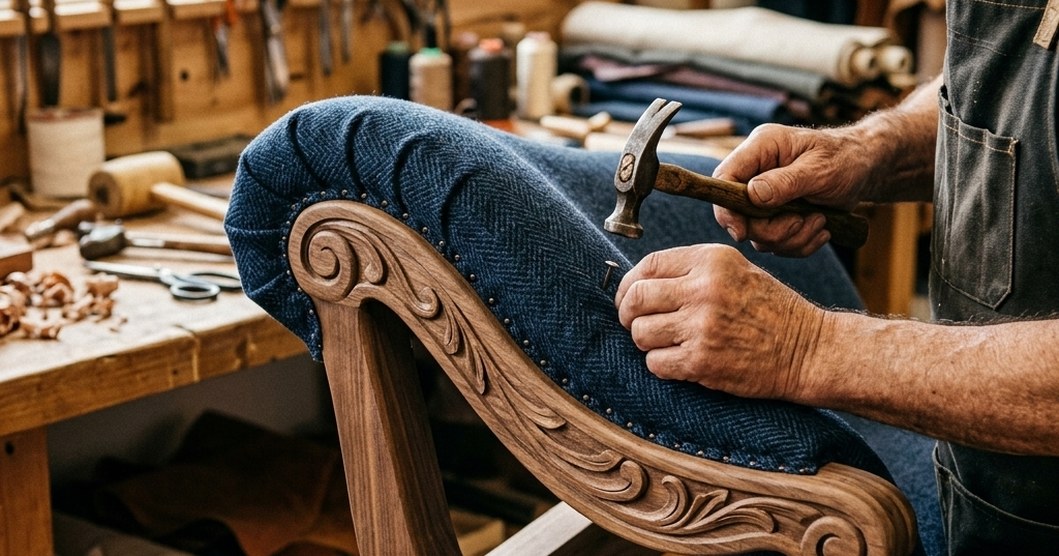
Behind every custom furniture piece that leaves our workshop in Veron there is a well-equipped workshop. Artisan talent is not enough: the right tools let wood be cut with precision, upholstery be stapled with uniformity, and finishes feel impeccable to the touch. In this guide we review what tools and equipment a workshop truly needs to build custom furniture, drawing on our experience working with the humid Caribbean climate.
Over the years we have equipped and grown our workshop to serve residences, hotels, restaurants, and villas across Punta Cana, Bavaro, and Cap Cana. That journey taught us which equipment is worth every peso and which is simply unjustifiable spending. This is what really matters.
Workbenches and the foundation of the workshop
Every serious workshop starts with the workbench. It is the surface where cutting, assembly, and measuring happen; if it is unstable, everything placed on it inherits that instability. A solid wood bench with a thick top, fixed so it does not vibrate, is the silent investment that pays off on every project.
Alongside it, a wood lathe and assembly clamps complete the work station. For premium pieces, a bench with storage drawers keeping saws, chisels, and squares within easy reach saves invaluable minutes each day. In Caribbean climates, the workshop foundation must also resist humidity, with stabilized woods that do not warp with the change of season.
Carpentry machinery: saws, planers, and routers
Machinery is the heart of precision carpentry. A table saw and a panel saw deliver straight, repeatable cuts —essential in custom furniture where a millimeter of difference shows at assembly. A band saw, meanwhile, is the king of curved cuts and panel resawing.
The bench planer and router (table router) give that smooth finish and the decorative profiles that distinguish a luxury piece from an ordinary one. For the fine cabinetmaking that Cap Cana villas demand, a biscuit joiner and a sander/calibrator make the difference in invisible joints and perfectly flat surfaces. All of this machinery, well maintained and with safety guards, turns the workshop into a productive machine.
Upholstery tools: staplers, compressors, and needles
A piece is only as good as its upholstery, and upholstery depends on the air compressor. It powers the pneumatic stapler, which drives staples with uniform, deep force into wood and particleboard, without the fatigue of a manual stapler. For professional use we recommend a compressor with a tank of at least 50 liters and pressure of 6 to 8 bar, keeping pace through long days upholstering sofas and headboards.
Add to that upholsterer's needles, upholstery hammers, a staple puller, and electric shears for cutting fabric. Every detail counts: a well-set staple is one that does not come loose after years of daily use in a Punta Cana hotel, nor weaken with the humidity and salt air of the coast. This is where the real durability of a piece is won or lost.
Planning a custom furniture project?
Let us discuss your project →Finishing, sanding, and safety
The finish is what the client touches and remembers. The random orbital sander and belt sander prepare the surface, while rollers and spray guns apply marine varnishes and lacquers that withstand the tropics. In the East Zone, where humidity exceeds 75%, UV-protected finishes are not a luxury: they are a necessity so the wood does not fade or crack.
Alongside the finish comes safety. Dust extraction equipment protects the lungs, and safety glasses, a respirator mask, and earplugs or ear protection are mandatory before saws and compressors. A workshop that prioritizes safety is a faster, more profitable workshop, because accidents become lost time and unexpected costs.
Investing well: which tools really matter
When someone is thinking about setting up a furniture workshop in Bavaro or Veron, the instinct is to buy everything. Experience says otherwise: invest first in the tools you will use every day —workbench, saws, sanders, compressor, and stapler— and choose quality over quantity. A good tool lasts decades and produces better results than three cheap ones.
At Casa Velura we apply this philosophy to every project. Our Veron workshop combines professional-level carpentry machinery and upholstery tools to deliver sofas, headboards, chairs, and benches that withstand heavy use and the Caribbean climate. Because we know that interior design is the art of turning noble materials into pieces that endure.
A craft is defined by its tools and its dedication to detail.